Assessment-3
| Assessment type | Project | Individual |
|---|---|
| Length | 5000-8000 words (+/-10%) | and 1-2 minutes with 5-10 slides (+/-10%) |
| Weighting | 40% |
| Due date | Week-13 |
Overview
This task is designed to provide a comprehensive, hands-on experience that integrates all the knowledge and skills acquired throughout the course. Guided by RMIT’s 3A Pedagogy (Active, Applied, Authentic Learning), this task challenges you to apply your learning to a real-world digital marketing scenario with the following objectives:
Authentic Learning: You will work on a substantial digital marketing challenge, potentially in the form of a consulting brief for an existing company or a detailed simulation of an industry problem. This ensures the project is highly relevant and mirrors the complexities faced by digital marketing professionals in the field.
Applied Learning: The project requires you to apply advanced digital marketing concepts, strategies, and tools from across the course modules. You will develop practical, viable solutions and present them in professional formats: a comprehensive report detailing your analysis, strategy, and proposed implementation, as well as a compelling presentation to effectively communicate your findings and recommendations.
Active Learning: This task demands continuous, hands-on engagement, critical thinking, and problem-solving. It encourages you to actively research, strategize, and create, building upon the foundational knowledge and practical skills developed through earlier course activities and discussions.
Learning Outcomes
The targeted Course Learning Outcomes (CLOs) for this assessment are:
- CLO-1. Critically analyse the complexity of the digital marketing landscape to communicate strategic insights to specialist and non-specialist audiences.
- CLO 2: Research, develop, and justify innovative and ethically responsible solutions to authentic digital marketing problems faced by firms.
- CLO 3: Apply data literacy and quantitative skills to interpret metrics, assess performance, and derive insights into customer and firm behaviour.
- CLO 4: Evaluate and design seamless customer experiences across evolving digital marketing environment.
Marking Criteria
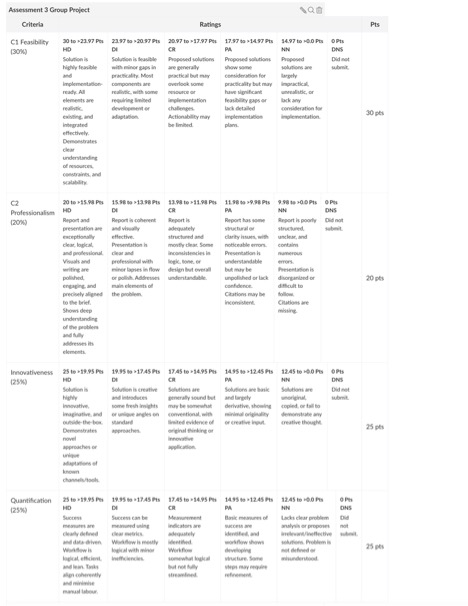
Introduction
We introduce a business case that provides the details of the firm. Then, based on this business case, you will work towards the course project. The course project assesses the student’s ability to understand the existing digital marketing strategies of the focal company and how to improve them.
To successfully address the problems in the course project, students must clearly understand the business context of the focal company. Therefore, students are encouraged to explore the firm’s online/offline presence, as well as its digital activities.
Business Case
We will be working with a liquor products retailer from the Buffalo region in New York, United States. The retailer is the market leader in the area and has received national recognition (e.g., Wine Spectator Retailer of the Year). The following are the details of the retailer.
- Name: Premier Group
The retailer sells its liquor products through three distinct physical stores.
- Premier Wine and Spirits (winedeals)
- Premium Wine and Spirits (winetransit)
- Prestige Wine and Spirits (winemadeeasy)
The retailer also has a gourmet store.
The retailer’s online presence and digital activities can be summarized as follows.
- Multichannel strategy: The retailer adopts a multichannel strategy (click-and-brick strategy) whereby it sells its products via two main channels.
- Offline channels (or physical stores)
- Online channels (or websites)
- Social media marketing: The retailer also has an active social media presence on the following major platforms.
- Email Marketing
- The retailer maintains an active email marketing program. Consumers can subscribe to their email opt-in list and receive email newsletters that inform consumers about promotions, new product launches, special events, and reminders. The following is a typical sample of an email newsletter sent by the retailer

- Other marketing mix activities: The retailer is also involved in other forms of marketing mix activities such as:
Problem Overview
A digital marketing strategy enables a company to identify what makes its offering unique and determine how to communicate this to its audience through various digital channels effectively. Adopting a customer-centric approach enables marketers to identify their customers’ needs, interests, and pain points, thereby optimizing their digital messaging. Companies rely on their digital marketing strategy to guide their marketing actions and measure their results.
To succeed in this assessment, you need to apply a deep understanding of the business environment and how customers engage with the company to propose an innovative digital marketing strategy. You also need to evaluate and prioritize the company’s media selection to achieve defined marketing objectives. Finally, you must suggest ways to incorporate multichannel, multimedia, and mobile marketing and determine metrics for success.
Problem Details
In this assessment, you are provided with a company case study. You will prepare a report that includes an evaluation of the company’s current marketing communication and your proposed digital marketing strategy. You will also develop a presentation that summarizes your digital marketing strategy. The report and presentation are to be delivered to a Senior Marketing Manager and a Finance Manager from the company. As such, you should communicate at a suitable professional level, using specialized terms and concepts appropriate to their expertise. Use the structure and guiding questions outlined below when constructing your report.
- Introduction
- An overview of the company, for example the industry it operates in,mission, and primary objectives
- The main purpose of the report
- Analysis of business
- Evaluate and articulate the company’s marketing objectives
- Include a customer experience journey map in which you identify and discuss customer pain points
- Analyze the company’s marketing communication
- Identify and explain the benefits and limitations of the current marketing communication
- Focus on customer relationship management and marketing return on investment
- Identify and explain the problem(s) with the company’s current marketing strategy based on your analysis
- Digital marketing strategy
- Discuss the strategies the company can use to synthesize its existing channels to create a consistent experience for customers across those channels
- Explain how you would implement a strategy for multichannel, multimedia, and mobile marketing that aligns with the company’s business goals and brand
- Propose solutions to eliminate the customer pain points identified in the customer experience journey
- ROI of digital marketing strategy
- Define metrics to measure the success of your proposed digital marketing strategy and explain why you have chosen these metrics
- Discuss how your digital marketing strategy will enhance customer relationship management and the customer experience
- Describe any limitations of your digital marketing strategy
- Conclusion
- References
- Accurate referencing in RMIT Harvard style
- A good mix of valid and reliable sources
- Appendices
- Any supporting analysis, diagrams, pictures, or other relevant materials that enhance the main report should be included in this section
Presentation
You are required to deliver a presentation in which you summarize your digital marketing strategy. You need to explain your strategy and how it will add value to both the business and the customer. It is recommended that you use PowerPoint slides to aid your presentation. The number of slides that you wish to include 5-10. However, be mindful of the time limit (1-2 minutes). Use your creativity and judgement to determine the amount of information you want to include and how you will present your content visually.
You could include the following themes from your report to present.
- Enhancing the customer experience journey
- Synthesizing multichannel multimedia marketing
- Implementing mobile marketing
Use these questions to guide your presentation.
- Why did you choose to focus on this aspect of your digital marketing strategy?
- What is your strategy? Lay this out in steps.
- What value does your proposed strategy add to the business?
- How does your strategy address customer pain points?
- What are some examples of success in this area in similar industries/businesses?
- How did you decide on the metrics to measure performance in this area of your digital marketing strategy?
Referencing Guidelines
Use RMIT Harvard referencing style for this assessment.
You must acknowledge all the information from the course you have used in your assessments.
Refer to the RMIT Easy Cite referencing tool to see examples and tips on how to reference in the appropriate style. You can also refer to the library referencing page for more tools such as EndNote, referencing tutorials, and referencing guides for printing.
Submission Format
Submit your report and presentation (slides and video) on Canvas as a file upload via the Turnitin link on the Assessment 3 page.
Your presentation will be Pre-recorded presentation with your face visible.
If the recording exceeds the Canvas upload limit, please upload it to YouTube and submit the link instead. Please ensure that the video is publicly accessible.
Academic integrity and plagiarism
Academic integrity is about the honest presentation of your academic work. It means acknowledging the work of others while developing your own insights, knowledge, and ideas.
You should take extreme care that you have:
- Acknowledged words, data, diagrams, models, frameworks, and/or ideas of others you have quoted (i.e., directly copied), summarized, paraphrased, discussed, or mentioned in your assessment through the appropriate referencing methods.
- Provided a reference list of the publication details so your reader can locate the source if necessary. This includes material taken from websites.
Suppose you do not acknowledge the sources of your material. In that case, you may be accused of plagiarism because you have passed off the work and ideas of another person without appropriate referencing, as if they were your own.
RMIT University treats plagiarism as a severe offence, constituting misconduct.
Plagiarism covers a variety of inappropriate behaviours, including:
- Failure to properly document a source
- Copyright material from the internet or databases
- Collusion between students
For more information on our policies and procedures, please visit the University website.
Assessment declaration
When you submit work electronically, you agree to the assessment declaration.