AI in Customer Experience Management
Advanced Digital Marketing
Agenda
Artificial Intelligence
AI in Marketing Mix Strategy
Generative AI
Conversational AI
Agentic AI
Digital Homogeneity
Artificial Intelligence
Pattern Recognition
Human brain is very good at recognizing patterns.
- Example: Face recognition, speech recognition, handwriting recognition
Humans have long fascination with building machines that can recognize patterns.
Early AI research focused on building systems that could mimic human pattern recognition abilities.
- Ranking
- Recommendation
- Classification
The early approaches were based on data mining.
- Turning large collection of raw data into useful information.
Machine Learning
Machine Learning (ML) is an all-encompassing term which involves processing the data to look for
trendsandpatterns.ML
algorithms1 improves automatically through experience based on data.Data is fundamental in ML.
- Training data - [Validation data] - Test data
Application of ML
- Predictive analytics
- Natural Language Processing (NLP)
- Computer Vision
- Speech Recognition
Why ML
- Data
- Large amount of data (e.g., big data) is now available
- Easier to produce, collect, and store large amounts of data
- Computational Power
- More powerful processing available
- Cheaper to access
- Hardaware independent
- Algorithms
- More sophisticated algorithms developed
- Open source libraries available
Where does AI fit in
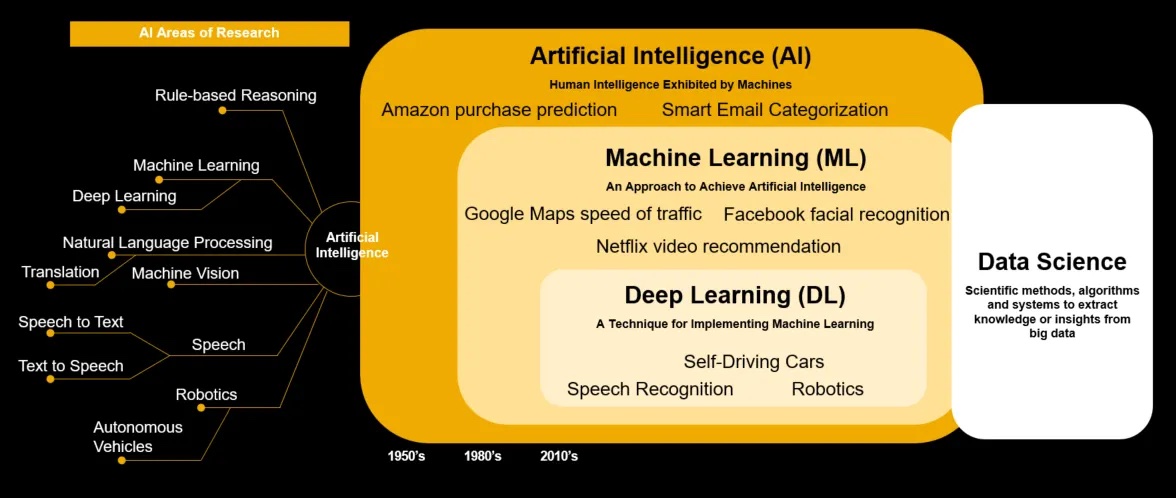
AI: Simulation of human intelligence in machines
ML: Subset of AI that enables machines to learn from data
Deep Learning: A technique to implement ML using neural networks
Data Science: Scientific methods, algorithms and systems to extract knowledge or insights from big data
Generative AI vs. Agentic AI
- Generative AI
- Focuses on creating new content
- Large Lanugage Model (LLMs) like are part of Generative AI
- Examples: ChatGPT, DALL-E, Midjourney
- Agentic AI
- Focuses on autonomous decision-making and actions
- Examples: Autonomous vehicles, robotic process automation
Domain Knowledge in AI
Domain expertise transforms algorithms into impactful innovations.
- Raw technical AI skills are powerful, but without deep understanding of the problem space, solutions are fragile, irrelevant, or even harmful.
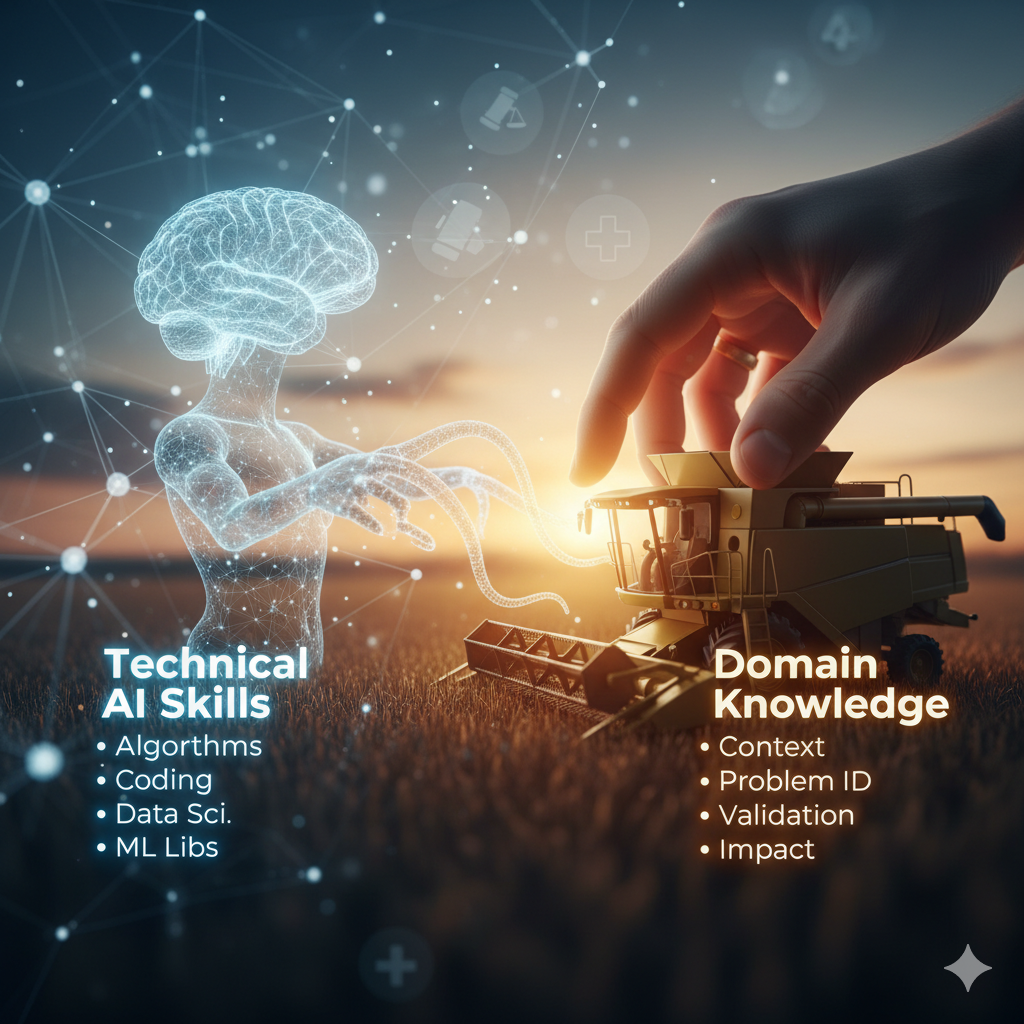
Human-in-the-Loop
What AI Can Do:
✅ Process millions of data points
✅ Identify complex patterns
✅ Generate predictions at scale
✅ Create content in seconds
✅ Automate repetitive tasks
What AI Cannot Do (Yet):
❌ Understand business strategy
❌ Know industry regulations
❌ Recognize cultural nuances
❌ Question data quality
❌ Make ethical judgments
→ This is where YOU come in
Important
The most powerful AI systems combine machine intelligence with human domain expertise
Reflection
Scenario
You are the new marketing manager for a company launching a new energy drink. The tech team just spent $1 million on a new AI called ‘Slogan-Bot.’ They run the AI, and in 30 seconds, it generates a list of 1,000 technically perfect ad slogans. They email you the list and say: ’The AI did its job. Now it’s your turn. Go make us money.
Pair in two
Ask your partner this question and take turn.
The AI has finished its technical job. What is your job?
Hints:
- List all the marketing questions you must answer and the actions you must take before you can use a single one of those 1,000 slogans.
- Reflect on what
domain knowledgeis required to turn that raw list into a successful campaign.
AI in Marketing Mix Strategy
AI Intelligence for Marketing
- Mechanical AI - Automates repetitive and routine tasks
- Examples: Data collection, remote sensing, classification algorithms
- Benefit: Standardization (consistency and reliability)
- Thinking AI - Processes data to arrive at decisions
- Examples: Machine learning, neural networks, recommender systems
- Benefit: Personalization (pattern recognition from data)
- Feeling AI - Analyzes interactions and human emotions
- Examples: Sentiment analysis, NLP, chatbots, affective analytics
- Benefit: Relationalization (personalizes relationships)
AI transforms the marketing mix by providing:
- Standardization through mechanical AI (efficiency & consistency)
- Personalization through thinking AI (data-driven customization)
- Relationalization through feeling AI (emotional engagement)
Note
Strategic implementation requires matching the right AI intelligence to each marketing function for maximum impact.
Product: AI for Cusotmer Needs
- Mechanical AI Applications:
- Track and monitor product adoption automatically
- Automate logo design (e.g., Tailor Brands)
- Thinking AI Applications:
- Predict fashion trends (e.g., Gap uses predictive analytics)
- Personalize diet algorithms for individual consumers
- Brand tracking through text analysis
- Service innovation through topic modeling
- Feeling AI Applications:
- Train chatbots with brand personality
- Recommend content based on viewer’s mood
- Provide emotional comfort through conversational AI
- Analyze and respond to customer emotions in real-time
Price: AI for Cost Optimization
- Mechanical AI Applications:
- Automatic payment systems (Apple Pay, Google Pay, PayPal)
- Automate routine pricing tasks
- Thinking AI Applications:
- Personalized pricing based on individual customer data
- Machine learning for price optimization by product, channel, and customer
- Dynamic pricing using multiarmed bandit algorithms
- Real-time price adjustments with incomplete information
- Incorporate consumer WOM and private information for pricing
- Feeling AI Applications:
- AI-powered price negotiation
- Detect customer sentiment during pricing discussions
- Interpersonal likeability impacts negotiation outcomes
Place - AI for Convenience
- Distribution & Logistics:
- Mechanical AI: Collaborative robots for packaging, drone delivery, IoT for consumption tracking, self-service automation
- Thinking AI: Anticipatory shipping, self-driving delivery vehicles
- Feeling AI: Facial recognition for customer identification
- Retailing & Frontline:
- Mechanical AI: Self-checkout, hazard detection robots, automated delivery robots
- Thinking AI: Personal shopping assistants, smart mirrors with recommendations
- Feeling AI: Customer greeting robots, emotional engagement in service interactions
Promotion - AI for Communication
- Mechanical AI Applications:
- Automate targeting and retargeting campaigns
- Automate media scheduling and buying
- Real-time posting, bidding, and content updates
- Push notifications to consumer devices automatically
- Thinking AI Applications:
- AI writers create personalized content
- Personalized campaigns
- Ad analytics for content optimization
- Identify social media influencers
- Personalize search using social influence
- Feeling AI Applications:
- Track audience emotions and personalize ad messages
- Create engaging personalized content
- Emotion sensing from conversational content
- Enhance consumer engagement through NLP analysis
Customer Journey in the age of AI
- Aggregate-level purchase funnel from firm’s perspective
- Linear progression
- Periodic, delayed data collection
- Manual analysis and decision-making
- Individual-level continuous journey with feedback loops
- Real-time tracking across devices and channels
- Context-dependent personalization at each touchpoint
- Automated optimization using machine learning
Four Key AI-Driven Trends Shaping the Journey:
- Interactive & Media-Rich: Consumers engage through text, images, video—AI processes all formats
- Personalization at Scale: From segments to microsegments to individual-level targeting
- Real-Time Automation: Millisecond decisions for hundreds of microsegments
- Holistic Journey Focus: Monitor and guide consumers through entire lifecycle, not just conversion
AI Funnel
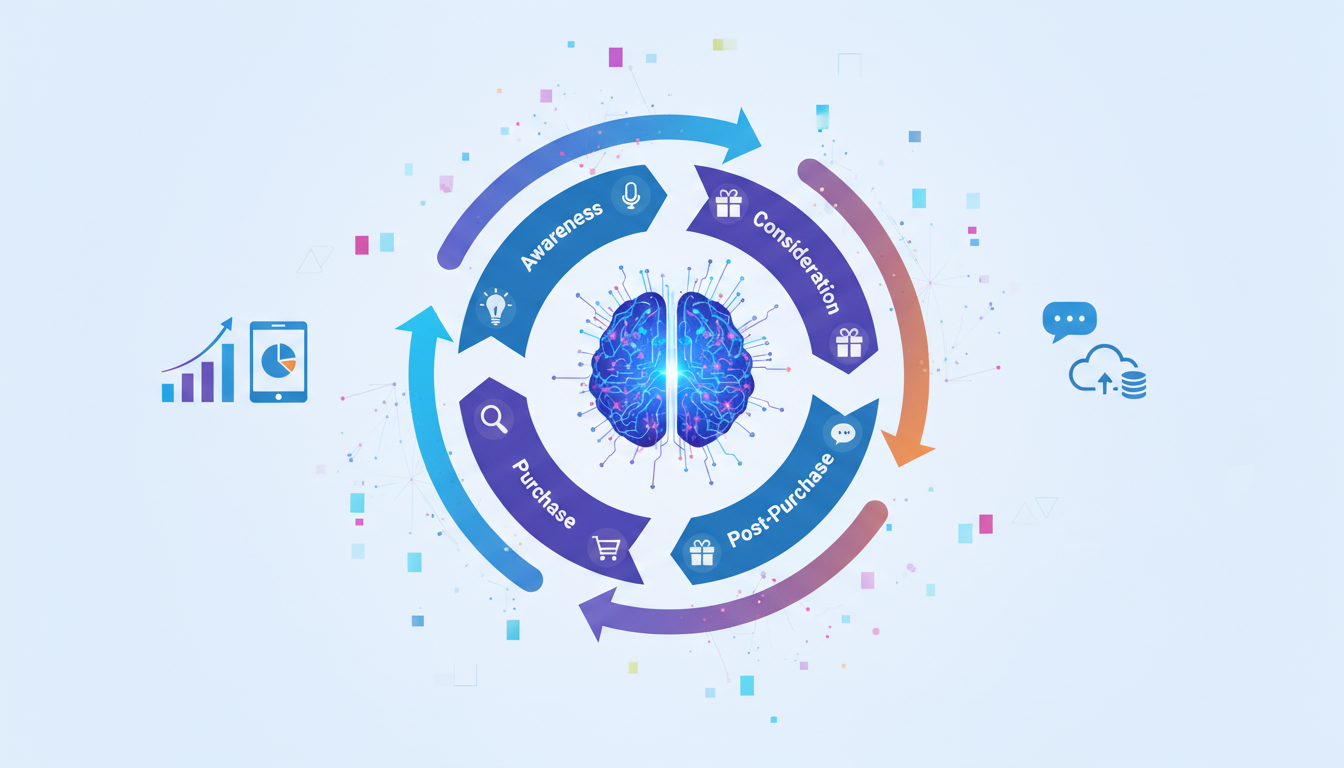
Role of AI in Customer Journey
Pre-Purchase
- Search Optimization: Deep learning improves search relevance
- Content Analysis: Topic models and sentiment analysis anticipate/shape demand
- Lead Identification: Predictive analytics identify prospects
During Purchase
- Dynamic Pricing: Reinforcement learning optimizes prices in real-time
- Product Recommendations: Collaborative filtering + deep learning match products to consumers
- Conversion Optimization: Multi-armed bandit algorithms test and optimize tactics
Post-Purchase
- Experience Monitoring: NLP analyzes customer feedback across channels
- Churn Prevention: Predictive models identify at-risk customers
- Lifetime Value Optimization: Reinforcement learning guides long-term engagement strategy
Attribution & Learning
- Multi-Touch Attribution: Probabilistic graphical models assign credit across touchpoints
- Continuous Improvement: Algorithms learn from each interaction to refine future decisions
- Critical Challenge: Firms must balance automation and scale with marketing insights and theory to create effective, ethical customer journeys.
Reflect
Context: You are the new CMO for “Urban Roots,” a mid-sized organic grocery delivery service. While the logistics are solid, customer churn is high, and the brand feels “cold.” The CEO wants to integrate AI not just for efficiency, but to build relationships.
Task: Using the framework discussed, map one specific AI application to solve the following three business problems. You must be precise about which type of AI (Mechanical, Thinking, or Feeling) you are deploying and why.
- The “Product” Problem (Freshness Guarantee): Customers complain that produce spoils too quickly, but you don’t know when to harvest or restock specific items.
- Required AI Type: Mechanical AI (Focus: Standardization/Remote Sensing)
- Your Solution: ___________________
- The “Price” Problem (The Discount Trap): You currently send a generic 10% off coupon to everyone on Fridays. It’s eating margins. You need to maximize revenue while retaining cost-conscious buyers.
- Required AI Type: Thinking AI (Focus: Personalization/WTP)
- Your Solution: ___________________ (Hint: Consider the “Multi-armed bandit” or “Willingness To Pay” concept).
- The “Promotion/Service” Problem (The Angry Chef): A customer emails complaining a recipe kit was missing an ingredient for a dinner party. They are furious. A standard automated “Ticket #402 Received” email will cause them to cancel.
- Required AI Type: Feeling AI (Focus: Relationalization/Sentiment)
- Your Solution: ___________________
Bonus: If you can integrate AI tools to solve the above problems while enhancing customer experience, you will be well on your way to becoming a successful AI-driven CMO!
Generative AI
What is Generative AI?
Generative AI refers to algorithms that can generate new content, such as text, images, audio, or video, based on patterns learned from existing data.
It uses deep learning techniques, particularly neural networks, to create content that mimics human creativity.
Examples include:
- Text generation (e.g., ChatGPT, Claude, Gemini, LLaMA)
- Image generation (e.g., DALL-E, Nano-Banana)
- Music composition (e.g., OpenAI Jukebox)
- Video synthesis (e.g., Google NoteBookLM)
- Speech synthesis (e.g., Google WaveNet, Whisper)
The first step of Generative AI is prompting.
Prompt Engineering
Prompt engineering is the process of designing and refining prompts to effectively communicate with generative AI models.
Effective prompts can significantly influence the quality and relevance of the generated content.
Key techniques include:
- Clarity: Be specific and clear about what you want.
- Context: Provide relevant background information.
- Constraints: Set boundaries or guidelines for the output.
Types of Prompts
- Zero-shot Prompts: The model is given a task without any examples.
- Example: “Write a poem about the ocean.”
- One-shot Prompts: The model is provided with one example to guide its response.
- Example: “Here is a poem about the sky: [example]. Now write a poem about the ocean.”
- Few-shot Prompts: The model is given multiple examples to learn from before generating a response.
- Example: “Here are some poems about nature: [example 1], [example 2]. Now write a poem about the ocean.”
- Chain-of-Thought Prompts: The model is guided through a step-by-step reasoning process.
- Example: “To solve this math problem, first identify the variables, then set up the equation, and finally solve for the unknown.”
- Instructional Prompts: The model is given explicit instructions on how to perform a task.
- Example: “List the top five benefits of exercise in bullet points.”
- Contextual Prompts: The model is provided with additional context or background information to inform its response.
- Example: “Given the following article about climate change, summarize the key points.”
- Interactive Prompts: The model engages in a back-and-forth dialogue to refine its output.
- Example: “What are the main causes of climate change?” followed by “Can you provide more details on human activities contributing to it?”
- Multimodal Prompts: The model is given inputs in multiple formats, such as text and images.
- Example: “Describe the scene in this image and write a short story about it.”
Elements of Few-shot Prompt
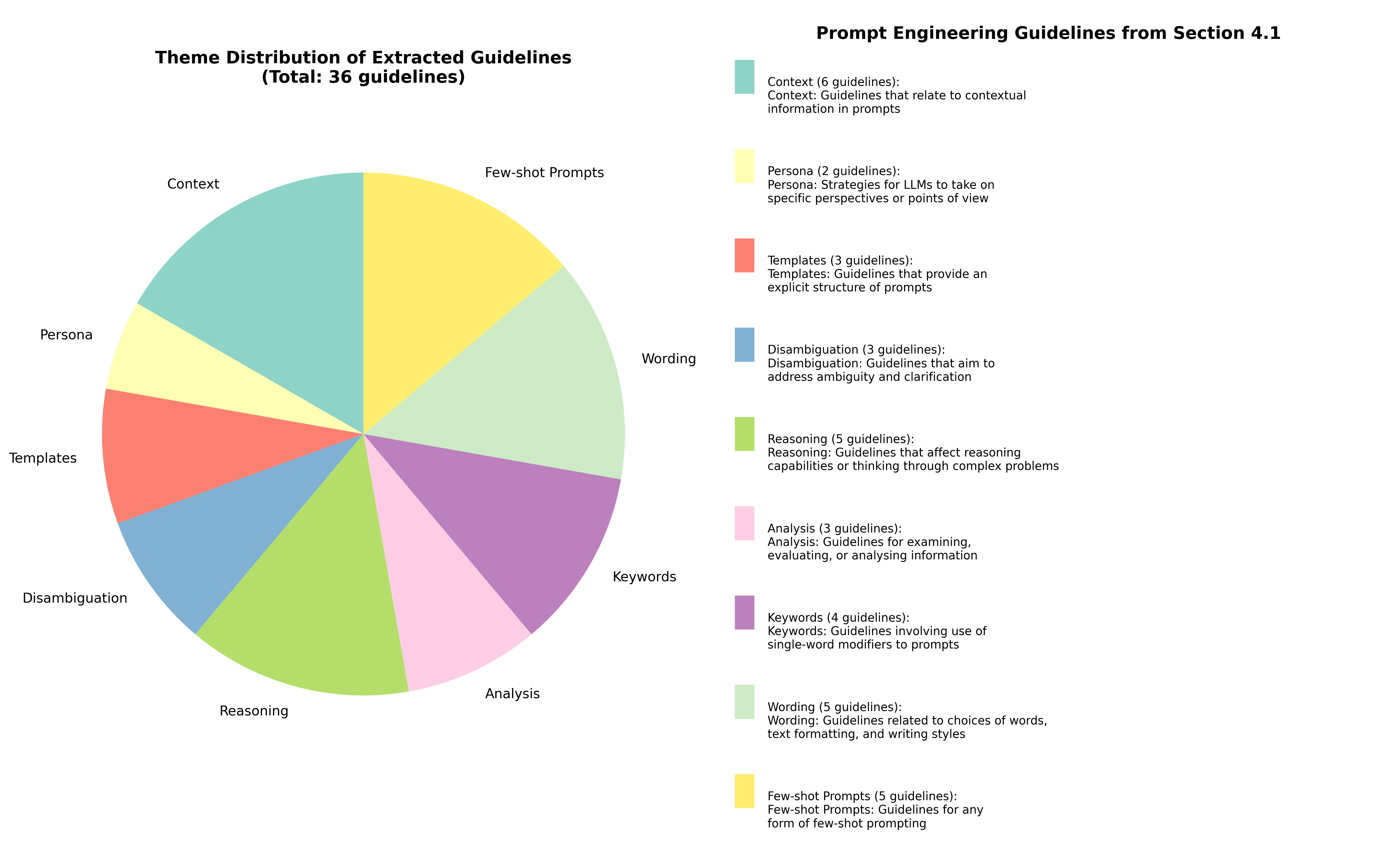
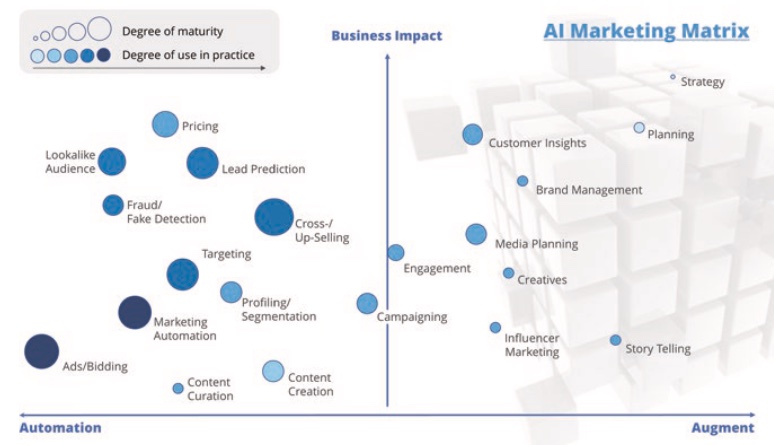
Use of GenAI in Industry
- Automation
- Content Creation: Automated generation of articles, blogs, and marketing copy.
- Personalization: Tailoring recommendations and experiences for users.
- Augmentation
- Design: Creating graphics, logos, and visual content.
- Customer Engagement: AI-powered chatbots for handling customer inquiries.
- Synthentic Data Generation: Creating training data for machine learning models.
Reflection
Scenario: Your team is building a food delivery app. You need to write requirements for the
order trackingfeature.Try first: Write one-shot prompt without any guidelines.
- Example: Generate requirements for order tracking feature.
Try second: Write few-shot prompt with guidelines.
- Example: Context: Add background info (e.g., target users, existing systems), Persona: Ask LLM to act as a specific stakeholder (customer, driver, restaurant), Keywords: Include specific terms (real-time, notifications, GPS), Reasoning: Ask it to “think step by step”, Disambiguation: Ask it to identify ambiguities.
Final task: Compare the outputs from both prompts. Which one is better? Why?
Bonus: Can you compare the outputs of the same prompts you developed across two GenAI platforms (e.g., ChatGPT vs. Claude)?
Conversational AI
Conversation with Machine
ELIZA was the first demonstration of communication between human and machine.
- It was created in 1966 by Joseph Weizenbaum at MIT.
In conversation with machine, communication and interaction are governed by algorithms that makes it very controlled.
However, with recent advances in AI, conversational AI has become more sophisticated and human-like.
Examples
- Chatbots (e.g., ChatGPT, Claude)
- Virtual Assistants (e.g., Siri, Alexa)
- Customer Service Bots
Chatbots
Chatbots are AI-powered programs that simulate human conversation multi-modal inputs (text, images, voice).
Chatbots decouples two steps when working with machine or computers.
- Application layer: Executes the backend logic, data retrieval, and functional tasks.
- Conversation layer: Handles natural language understanding, context, and flow.
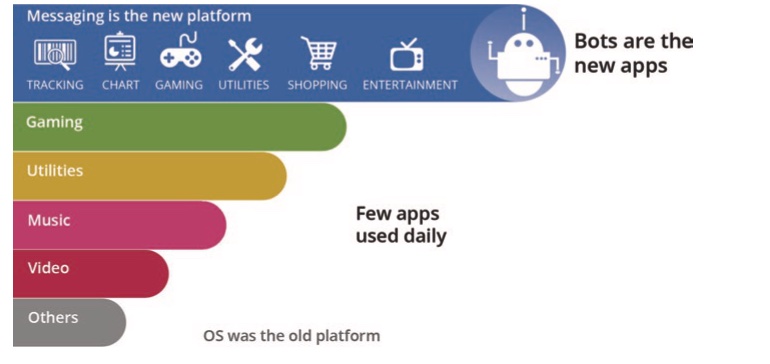
Chatbots have the potential to replace majority of website and apps.
Acting as a transactional operating system, the bot unifies the entire customer journey—from evaluation and purchase to service — eliminating the need for multiple apps or website.
Thus, chatbots are kind of a Centralized Hub for customers.
Benefits of Chatbots
Availability: Chatbots can provide assistance at any time, improving customer service.
Cost Efficiency: They can handle multiple inquiries simultaneously, reducing the need for human agents.
Scalability: Chatbots can easily scale to handle increased demand without significant additional costs.
Personalization: They can tailor responses based on user data and preferences.
Data Collection: Chatbots can gather valuable insights about customer behavior and preferences.
Consistency: They provide uniform responses, ensuring consistent customer experiences.
Quick Response Time: Chatbots can provide instant answers to common questions, improving user satisfaction.
Integration: They can be integrated with various platforms and services, enhancing functionality.
Multilingual Support: Chatbots can communicate in multiple languages, catering to a diverse customer base.
Risk of Chatbots
When chatbos interacts directly with people or indirectly via social media, the providers have additional ethical responsibilities.
ignorantia juris non excusat (ignorance of the law excuses not): Companies must ensure their chatbots comply with legal and ethical standards.
Humans tend to communicate obliquely, while robots think literally (Seitz, 2016).
Be transparent and informs users about shortcomings of chatbots and sometimes their unpredictable behaviors.

Conversational Commerce
- Conversational commerce refers to the use of chatbots and messaging apps to facilitate online shopping and customer interactions.
- This aligns with new consumer behavior where customers prefer conversational interactions over traditional browsing.
- For example, consumers interact with others via messaging apps more than social media platforms and would prefer the same when shopping online.
- Conversational commerce should cater to the entire stages of marketing funnels
- Awareness
- Consideration
- Purchase
- Retention
- AdvocacyConversational commerce is like having a digital concierge that guides customers through their shopping journey, providing personalized assistance and recommendations at every step.
Rise of Messenger Apps
- Average Monthly time spent
- WhatsApp: 17 hours, 6 minutes
- Line: 8 hours, 14 minutes
- Telegram: 3 hours, 45 minutes
- Snapchat: 3 hours, 33 minutes
- Facebook Messenger: 3 hours, 21 minutes
- In-app purchase revenue
- Snapchat $24.77 million
- Line $12.92 million
- Telegram $8.08 million
- WeChat $6.97 million
- QQ $4.51 million
- KakaoTalk $3.71 million
Source: 10 Most Popular Messaging Apps In 2025 (Data + Trends)
A Case: WeChat
- The oldest implementation of Conversational Commerce took place via WeChat.
- A mobile cross-platform messaging service from China that started in 2011.
- WeChat allows users to perform a variety of tasks within the app, including:
- Messaging
- Social media interactions
- Mobile payments
- Booking services (call taxi, order food, etc.)
- Shopping online
- Many companies have joined WeChat to leverage its vast user base for marketing and customer engagement.
- Customer comfort beats branding.
- Further reading: WeChat: How to Build a Super App and Why Western Companies Struggle
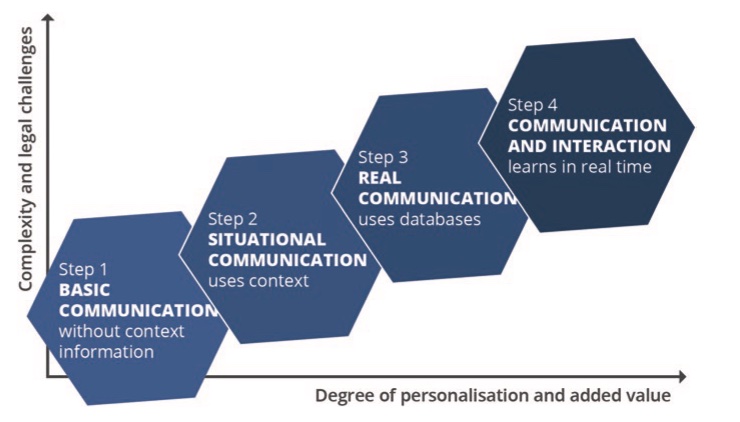
Building Chatbots
Reflection
We’ve established two contradictory realities about Chatbots and Conversational AI:
- The Structural Reality: Chatbots are merely “
Transactional Operating Systems” or a “Centralized Hub.” - The Social Reality: We treat them like humans. We project personality onto algorithms. The “Case of WeChat” proves that users prefer staying inside a conversational interface (“Customer comfort beats branding”).
Does the convenience of Text (the medium) sacrifice the authenticity of Voice (the human nuance), and if so, can a chatbot ever truly build Connection (retention/advocacy), or is it just a more efficient vending machine?”
Agentic AI
What is Agentic AI?
- Agentic AI refers to artificial intelligence systems that possess autonomy, decision-making capabilities, and the ability to perform tasks independently.
Agentic Shopping Tools
Characteristics of Agentic AI
- LLM-powered autonomous systems: Operates without human intervention.
Generative AI
- Task: Write me 10 subject lines for a spring sale
- Response: Here are 10 subject lines
Agentic AI
- Task: Launch a successful spring sale campaign.
- Response: I’ve run the campaign. The A/B test is complete, and budget is re-allocated. Here’s the 3-day report.
- These agents can be given
memoryandgoalsto autonomously create emergent social behaviors.- It’s a powerful preview of how AI agents could simulate customer personas or entire markets.
- Gates (2023) conceptualizes the AI agent as a “
personal assistant” or “agent” that will fundamentally change how everyone interacts with computers
Marketing Funnel using Agentic AI
📢 Awareness: Autonomous agents will create, A/B test, and optimize thousands of personalized ad variants, managing budgets across platforms in real-time to maximize ROI.
👀 Consideration: “Shopper Agents” (acting for users) will negotiate with “Brand Agents” to find the best product, price, and feature fit, changing how we think about search and comparison.
💰 Conversion: A single, unified agent will handle the entire transaction—from evaluation and purchase to service—within one persistent conversation, eliminating app fatigue.
❤️ Loyalty: Proactive agents will monitor customer data, predict churn, and autonomously initiate solutions, service, and rewards before a problem ever arises.
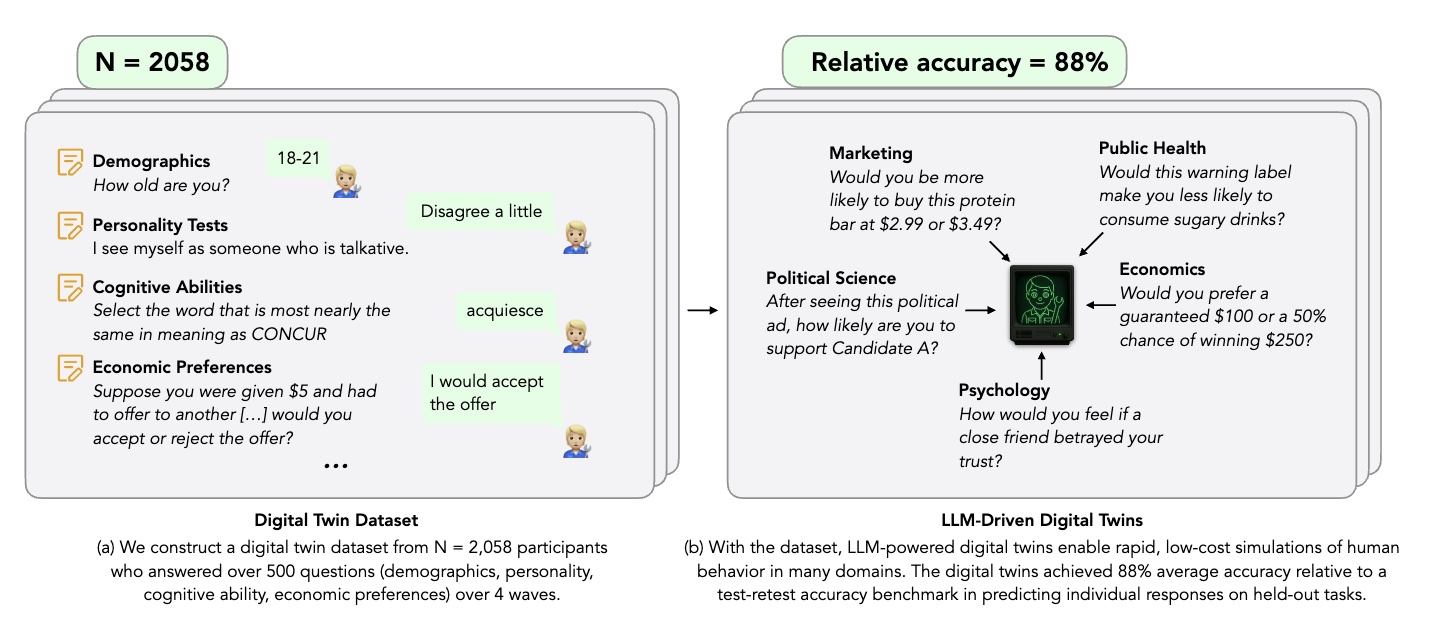
Digital Twins
- Digital Twins1: From “personas” to “silicon sample” for digital experimentation.
- Simulate consumer behavior at scale.
- Predict market trends and responses to marketing strategies.
Market Research
- Marketers can then use AI agents as virtual subjects to test and refine pitches, product ideas, and pricing strategies, allowing for “meticulous calibration” without the cost or fatigue of traditional, large-scale human surveys.
- LLM can be used to simulate consumer responses to marketing stimuli, providing insights into preferences, perceptions, and decision-making processes.
- Estimates of willingness-to-pay for products and features derived from LLM responses are realistic and comparable to estimates from human studies.
- Source: Using LLMs for Market Research
- Tool
- Expected Parrot
- Expected Parrot is an open-source framework and an interactive app to design, test, and simulate agents for surveys and research
Marketing in the Age of AI
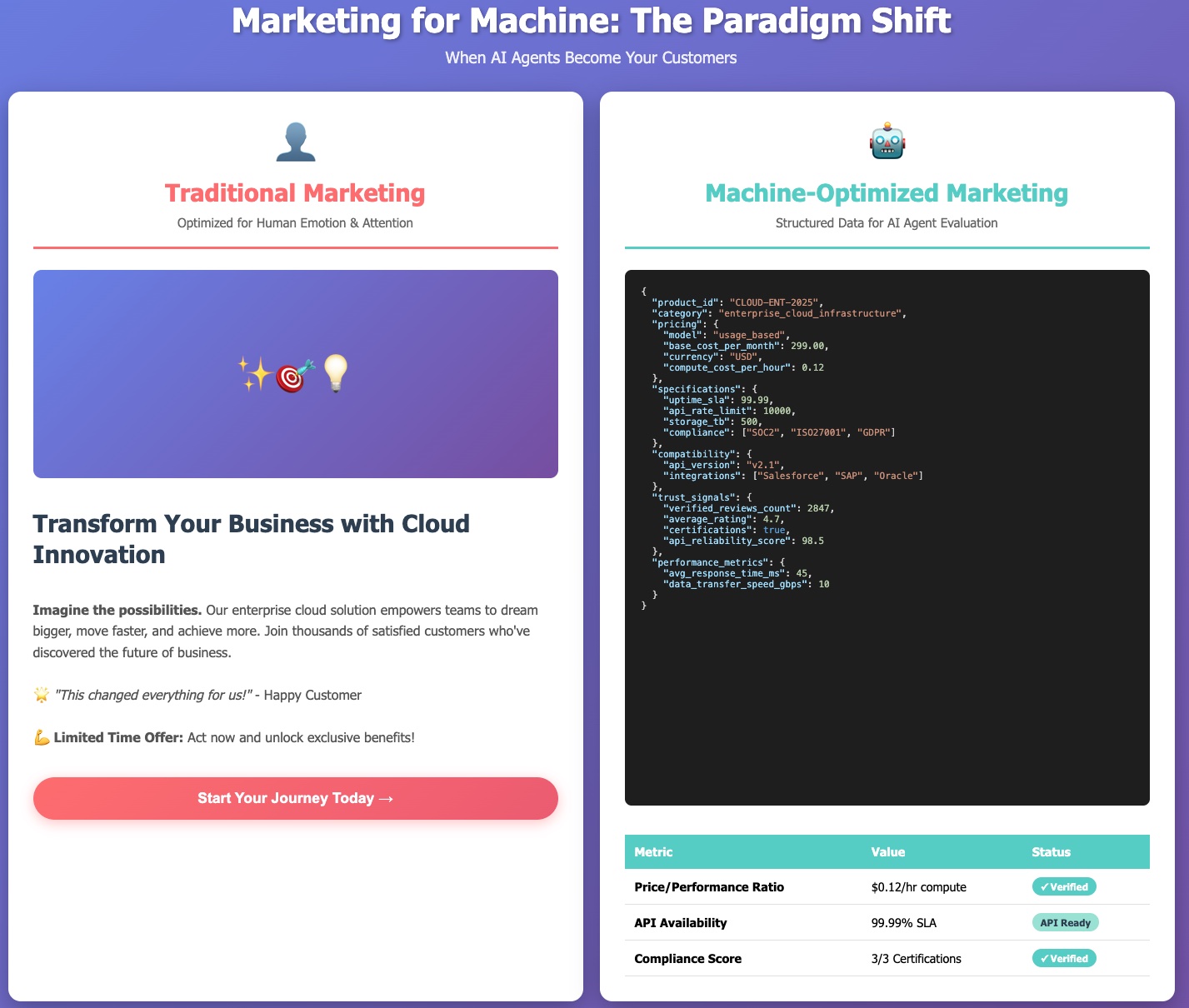
When AI agents make purchasing decisions for consumers, traditional emotional marketing gives way to data-driven, machine-readable optimization.
- Structured Data Over Storytelling
- AI agents prioritize parseable specifications, API integration, and structured product data
- Shift from SEO to “AEO” (Agent Engine Optimization)
- Objective Metrics Replace Brand Emotion
- Agents evaluate price-performance ratios, compatibility scores, and verified reviews
- Trust signals: certifications, API reliability, transparent pricing
- Programmatic Negotiation & Dynamic Pricing
- Real-time bidding between merchant bots and consumer agents
- Personalized offers generated algorithmically, not creatively
- Further reading: Marketing To Machines
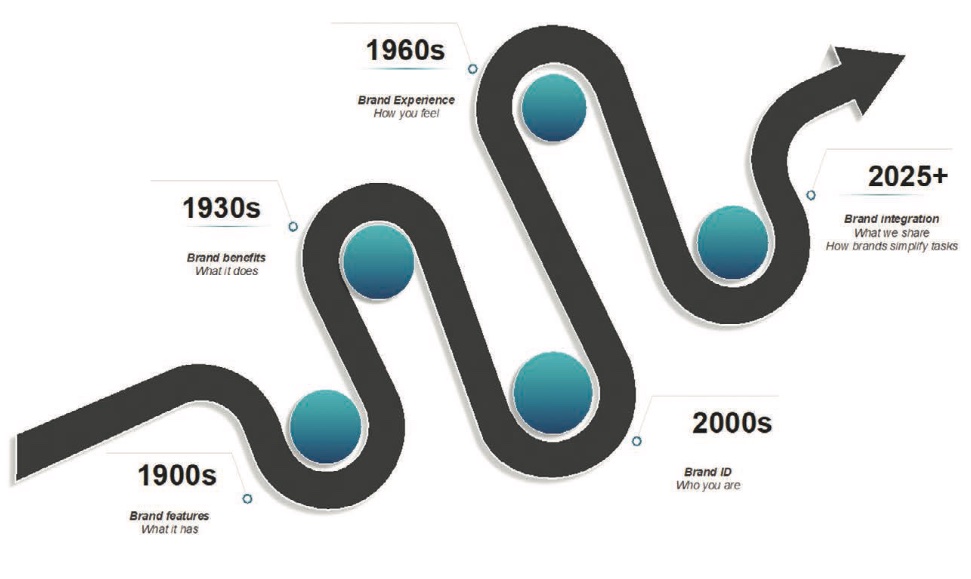
Marketing Evolution
Reflect
Task: Your goal is to launch a new premium, subscription-based coffee bean delivery service.
Copilot (Automation): First, mentally design a step-by-step “Copilot” process.
- What 3-4 simple prompts that you would use to manually build a market report? (e.g., 1. “List competitors.” 2. “Analyze their reviews.” 3. “Suggest personas.”)
Pilot (Autonomy): Now, mentally design a single, high-level “Pilot” prompt.
- What one major goal would you give an autonomous agent? (e.g., “Analyze the D2C coffee market, identify the top 3 un-met customer needs, and propose a launch strategy.”)
Reflection: Which process (Copilot vs. Pilot) do you trust more to give you a high-quality, actionable answer? Why?
- Consider risk factors.
- Related to Human-in-the-Loop concept.
Digital Homogeneity
Using AI without Human Insights
AI can generate content quickly and at scale, but without human insights, it may lack depth, context, and relevance.
Risks of relying solely on AI-generated content:
- Generic and repetitive outputs
- Lack of emotional connection
- Misalignment with brand values
- Ethical concerns (bias, misinformation)
Human insights are crucial for:
- Providing context and nuance
- Ensuring relevance to target audience
- Infusing creativity and originality
- Upholding ethical standards
Digital Homogeneity
Marketing in a digital environment is inherently tech-driven that has its own set of challenges.
When multiple brands deploy the same technology for their digital marketing strategies, it creates a risk of digital homogenization: a situation of
algorithmic monocultureandoutcome homogenization.Digital homogenization can lead to:
- Reduced differentiation among brands
- Decreased consumer engagement
- Stagnation in innovation
- Increased vulnerability to market shifts
Aversion to Algorithms
The risk of digital homogeneity is exacerbated due to consumers’ aversion to algorithms, known as algorithm aversion.
Consumers have a general tendency to distrust and reject outcomes from algorithms, even if they outperform human outputs, due to psychological factors.
- Lack of trust in machines and algorithms
- Low expectations about their capabilities and functioning
- Perceived loss of control over decisions (dehumanization)
If not algorith aversion, then risks still persist due to information overload.
- information fatigue
- cognitive overload
- information overabundance
The typical coping mechanism adopted by consumers is simplicity-seeking behavior, leading to filtering, avoidance, withdrawal, and non-seeking.
Back to Basics
Without emotion attached to an event, people don’t remember it.
Emotions \(\rightarrow\) Value Gain \(\rightarrow\) Memory Retention \(\rightarrow\) Story Telling
Humankind is composed of
body,soul, andmind.If you want to humanize your brand - think along those lines.
Reflection
Think about a recent brand interaction (ad, social media post, email) that felt generic or AI-generated to you.
- What made it feel impersonal or generic?
- What human element was missing?
- How did it make you feel about the brand?
- Pair with a partner discuss following issues (take turns)
- Share example
- Identify the missing human elements
- body (sensory/physical),
- soul (emotional/values), or
- mind (intellectual/context)
- Brainstorm: What could the brand have done differently to humanize the content?
If AI can create content faster and cheaper, what unique value do YOU bring as a future marketer?
Thank You!
🙏
Q&A
