
Personalized Digital Marketing
Advanced Digital Marketing
Agenda
Foundation
Permission-based Marketing
Email Marketing
Email Marketing Metrics
Recommender System
AI and Personalization
Foundation
What is Personalized Marketing?
Core Focus of any marketing strategy:
Delivering
Right Messageto theRight Personat theRight Time”
However,
- Customers’ primary concerns is their needs and wants.
- Furthermore, each customer has distinct preferences.
Hence, the need for personalized marketing.
Personalized Marketing
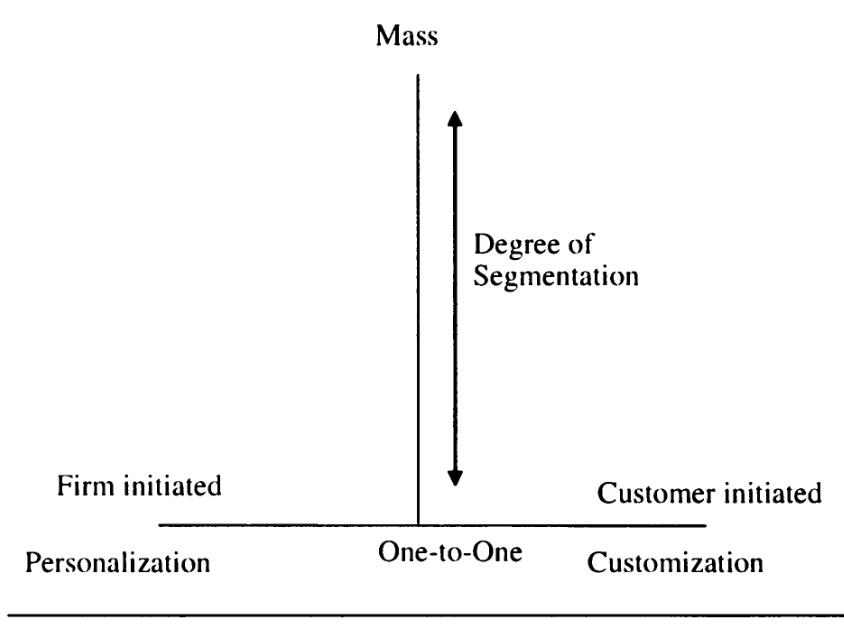
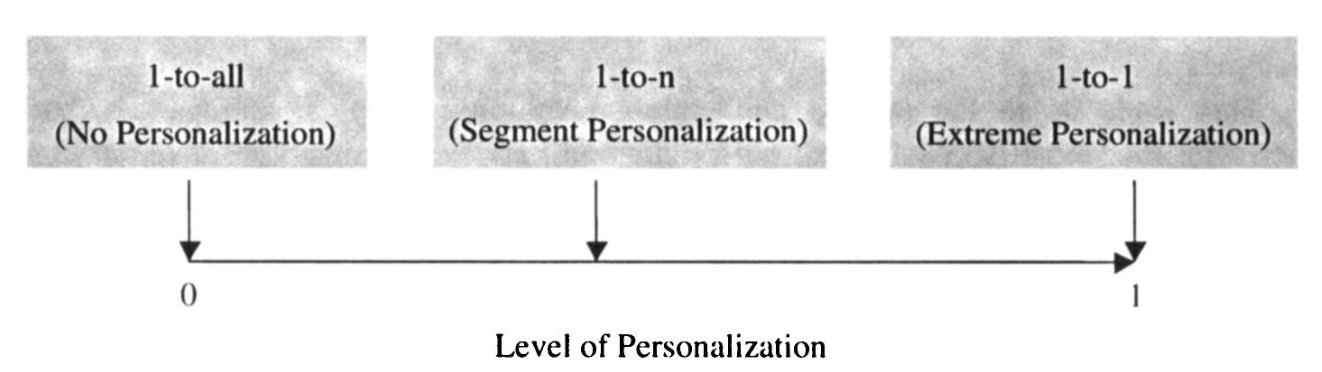
Personalized marketing is tailoring of messages or offers to individual consumers based on their actual preference and behavior.
It is a differentiating strategy at the customer level.
Customer Heterogeneity
Definition
Customer heterogeneity refers to the variability/differences in customer characteristics, needs, desires, and behaviors that affect their responses to marketing efforts. At its most fundamental level, it acknowledges that every single customer differs from another, requiring firms to adopt customer-centric approaches rather than one-size-fits-all strategies.
An Example: Netflix
One of the major success stories of personalization is the Netflix recommendation algorithm. In 2009-2010, Netflix launched a million-dollar challenge where they asked amateurs to increase the accuracy of their in-house algorithm by 10%. This led to significant interest and investment in personalized recommendations. The Netflix personalized recommendation system is reputed to save the firm over one billion dollars a year and is cited as one of the main reasons for the low churn rate at Netflix (Gomez-Uribe and Hunt, 2015).
Requirements
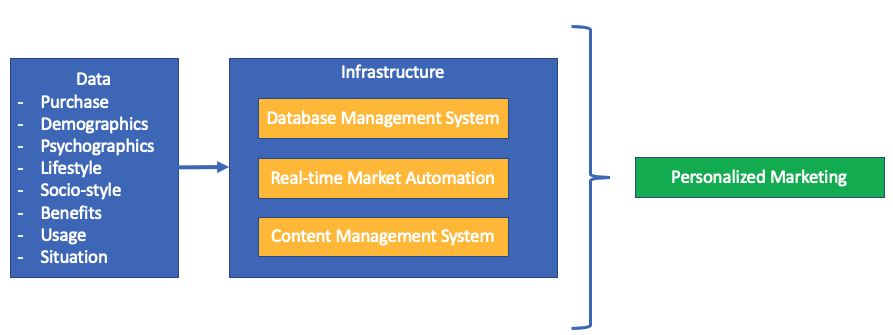
- Data Requirement
- Demographics, pyschographics, lifestyle, loyalty, socio-style, benefits, usage, situation, image, purchases.
- Infrastructure Requirement
- Database management system, real-time market automation tools, content management
Personalized Marketing: Step-1
- Understand
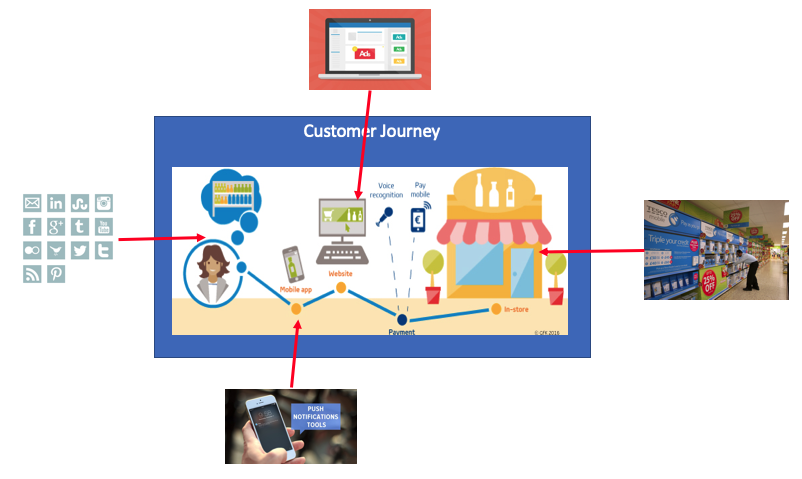
Customer Journey
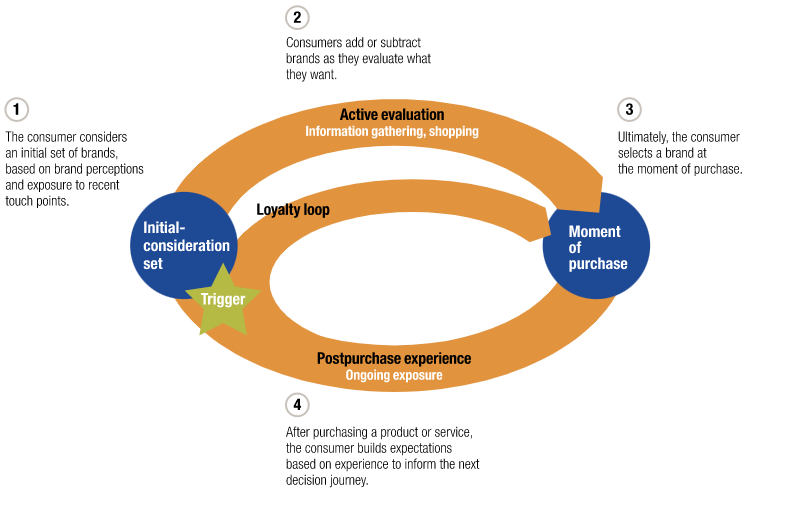
Consumers’ decision-making process is dynamic involving several steps.
Though most of the time marketers are interested in
purchase, there are many steps before consumers decide to purchase, and there are post-purchase actions that affect their loyalty with the brand.Consumer journey constitutes understanding of pre-purchase, purchase, and post-purchase consumer actions.
Personalized Marketing: Step-2
- Respond to consumer in real-time with relevant marketing message. In this stage, content marketing becomes very important.
Personalized Marketing: Step-3
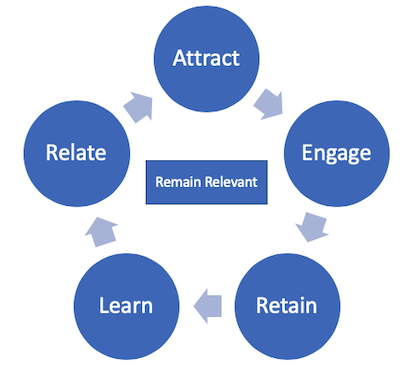
- Remain relevant
Role of Digital Marketing
- Two key requirement of personalization
- Real-time response (Marketing in the moment)
- Relevant content strategy
- Digital marketing environment facilitate these two key requirements.
- Personalized digital marketing communications
    - Emails
    - Short messaging service (SMS)
    - Push notification
- Online recommender system
- Chat bots
- Online Ads- Automation
Personalization Tools: Medium
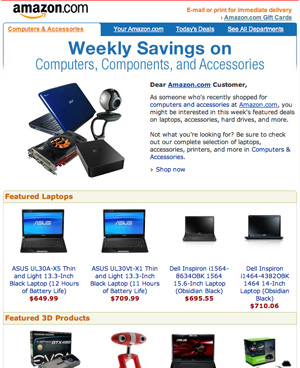
- Email marketing
- Online recommender system
Personalization Tool: Message
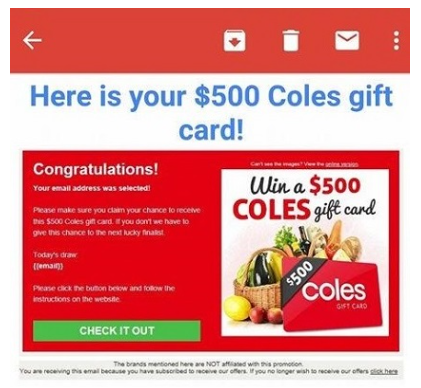
Reflect
Why Personalization Works?
Recall your personal encounter with a brand where you felt that the brand understood your needs and preferences.
Explain how the brand was able to do so?
What benefit did you get from that brand experience?
Did you find any concerns with that personalized marketing experience?
Permission-based Marketing
Definition
Definition
Permission Marketing is a fundamentally different way of thinking about advertising and customers. It is an approach to direct marketing that ensures taking customers’ consent to receive promotional communication.
POWERFUL ADVERTISING IS ANTICIPATED, PERSONAL & RELEVANT. (Seth Godin 2019)
Consumers
- Permission marketing guarantees consumers pay attention.
- Permission Marketing encourages consumers to participate in a long-term, interactive marketing campaign in which they are rewarded.
Firms
- It allows marketers to calmly and succinctly tell their story, without fear of being interrupted by competitors or Interruption Marketers.
- It allows marketers to personalize the contents.
Process of Permission Marketing
- Opt-In
- Opt-in marketing refers to firms explicitly asking customers for permission to sent their message. Customers have the option of opt-out any time.
- In Email marketing opt-in happens by collecting email addresses that require someone to make a positive selection in order to get added to the
list. - Self selection (positive consent)
- Opt-Out
- Opt-out marketing refers to firms sending promotional messages without prior permission from customers, but providing customers an option to opt-out.
- In email marketing it entails procedure of collecting email addresses that adds people to a list (unsubscribe) unless or until they ask to be taken off it.
- Negative Consent
Factors to Consider
Trust
- Institutional
- Individual
Experience
Control
Relevance
- Personal Characteristics
- Gender
- Age
- Nationality
Relevant Theories
Technology Acceptance Model: Permission seeking improves customers perceived usefulness and perceived ease of use of personalized digital tools.
Social Exchange Theory: Customers’ participation in an exchange situation is driven by their own self-interest and cost-benefit analysis.
Social Contract Theory: Consumers share their personal information with marketers, it is considered an implied social contract which is breached when marketing transaction occurs without consumers’ consent.
Privacy Calculus Theory: Customers make a trade-off between the benefits of personalization and the potential cost of loss of privacy.
Legal Considerations
In the United States federal CAN-SPAM Act became law in January 1, 2004 that discourages commercial entities to send unsolicited email messages.
The CAN-SPAM Act, a law that sets the rules for commercial email, establishes requirements for commercial messages, gives recipients the right to have you stop emailing them, and spells out tough penalties for violations (FTC).
CAN-SPAM Act identifies three kinds of email marketing messages:
- Commercial content - that advertises or promotes a commercial product or service
- Transactional or relationship content - that facilitates an already agreed-upon transaction or updates a customer about an ongoing transaction
- Other content - which is neither commercial nor transactional or relationship.
If the message contains only commercial content, its primary purpose is commercial and it must comply with the requirements of CAN-SPAM.
Reflect
- Recall a recent marketing message you received
- Did you give permission for it?
- Was it anticipated, personal, and relevant?
- Discuss with a partner:
- One example of
goodpermission marketing you’ve experienced - One example of
bad(interruption) marketing - What made the difference?
- One example of
- Who has opted OUT of marketing in the past month?
- Who has opted IN to marketing in the past month?
- What influenced your decision?
Email Marketing
Components of Email
- Electronic Mail
- Content
- Digital Message
- Subject
- Body of Message
- Signature
- Model of Delivery
- Internet
- Communicating Parties
- Sender (From)
- Receiver (To, CC, BCC)

The new information technology - Internet and email - have practically eliminated the physical cost of communications.
Email Tools
- Email Signature Generator
- https://www.hubspot.com/email-signature-generator
- https://www.mail-signatures.com/signature-generator/
- https://mysignature.io/
- Email Marketing Automation Tools
- MailChimp
- SendInBlue
- Sender
- Reply.io
Email Newsletter
Email Newsletter
Email newsletter contains content that is distributed to subscribers by email on a regular basis, at no cost to them, with the ulterior motive of generating direct sales or producing indirect benefits for the sending company or organization.
- Content
- promotional content
- e.g., special offers, sales announcements.
- non-promotional content
- e.g., articles, tips, Q&A, reminders.
- promotional content
- Subscriber
- Permission-based Marketing
- Direct Marketing
Email Marketing Terminologies
- Spam
- Commercial email sent to a list of people who have not asked to receive it.
- Bounce Message
- Message sent back to the sender of a newsletter informing them that an emailed issue could not reach a certain subscriber
- Hard Bounce
- Soft Bounce
- Message sent back to the sender of a newsletter informing them that an emailed issue could not reach a certain subscriber
- Clicks
- Customers clicking on links of email newsletters.
- Click-through rate
- Customers clicking on links of email newsletters.
- Open
- Customers opening an email newsletters
- Open rate
- Customers opening an email newsletters
- Unsubscribe
- Taking email address off the list of newsletter.
- Complains
- Unsubscribe rate
- Taking email address off the list of newsletter.
Email Marketing Goals
Formulation of Email Newsletter Strategy
- Acquisition of Customer
- Retention of Customers
- Generating Direct Sales
- Supporting Multichannel Sales
- Engaging, Interacting, Educating Customers
- Establishing Brand Value
- Driving Traffic to Online Channel
- Source of Entertainment
Building Audience Base
- Prospects for products and services
- Existing Customers
- Customers who buy from competitors
- The press/media
- Industry analyst
- Investors
- Affiliates or partners
Mistakes of Email Marketing
Spamming
- Solution: Opt-in
Distribution of Self Centered Messages
- Solution: Customize the email content
Expecting instant success
Not paying attention to the design of email content
- Subject line
- Content design
Only tool used for communication
- Integrate email marketing with other communication tools (IMC)
Being Passive
Effective Email Newsletter
Hook: During discovery process use
Hookto bait potential customers.Hub: Once onboarded, offer a
Hubto alleviate customer issues to develop better rapport.Help: Close the business deal by offering
Help.Action: Finally, drive customers to take
Action.
Reflect
Do you think email marketing will become an obsolete digital marketing strategy? Why? Who Not?
What products or services are best suited for email marketing? Why?
Email Marketing Metrics
Brainstorming
Review email messages sent to your email inbox.
Evaluate important parts of the email.
What actions do you perform with email messages?
Measuring Success
Metric to Quantify Success
- Decrease
- Sales time
- Cost of acquisition
- Investor churn
- Increase
- Average purchase size
- Frequency of purchase
- Customer life time value
- Market size
- Brand recognition
Cost of Email Marketing
- Distribution
- List Building
- Content Creation
Email Actions
- Open Rate \(\uparrow\)
- Unsubscribe Rate \(\downarrow\)
- Clickthrough Rate \(\uparrow\)
- Click-to-Open Rate \(\uparrow\)
Design of Newsletter
- Format
- HTML, Text, Pictures, Links, Banner Ads etc.
- Length
- Content, Size
- Frequency
- How often to send newsletter
- Timing
- Time of Day
- Day of Week (Weekend vs. Weekdays)
- Devices
- Computers
- Smart Phones
- Tablets
Typical Email Marketing Data
Delivery Rate (DR)
The email delivery rate (DR) for a newsletter or email campaign is defined as:
\[ DR = \frac{\text{Email Delivered}}{\text{Total Number of Emails Sent}}\]
Sender’ reputation determine the delivery rate. It indicates how spam-free your emails are.
- https://www.gmail.com/postmaster/
- https://senderscore.org/
- https://mxtoolbox.com/
Open Rate (OR)
The email open rate (OR) for a newsletter or email campaign is defined as:
\[OR = \frac{Total\; Users\; who\; Opened\; Email}{Total\; Users\; whom\; Email\; was\; Sent}\]
Sometimes, in the denominator instead of \(Total\; Users\; whom\; Email\; was\; Sent\), one can also use \(Total\; Users\; whom \;Email\; was\; Delivered\) which subtracts the total number of emails that were not delivered due to email bounce.
Marketers want high \(OR\). A high open rate for a newsletter indicates that the subject line of the newsletter resonates well with the recipient.
Thus \(OR\) is a metric that captures the percentage of consumers (to whom the newsletter was sent) who opened the newsletter. \(OR\) is calculated for a given email newsletter.
Unsubscribe Rate (UR)
The email unsubscribe rate for a newsletter or email campaign is defined as:
\[UR = \frac{Total\; Users\; Unsubscribed\; from\; Email}{Total\; Users\; whom\; Email\; was\; Sent}\]
Marketers want low \(UR\).
Thus \(UR\) is a metric that captures the percentage of consumers (to whom the newsletter was sent) who unsubscribed from the newsletter. \(UR\) is calculated for a given email newsletter.
Bounce Rate (BR)
The email unsubscribe rate for a newsletter or email campaign is defined as:
\[UR = \frac{Total\; Numbers\; of\; Bounced\; Emails}{Total\; Number\; of\; Emails\; Sent}\]
Bounce rate indicates the percentage of your total emails sent that could not be successfully delivered to the recipient’s inbox.
Hard Bounce
- Unknown email
- Email triggered a spam filter
- Incorrect file attachment
- Policy filtering
- Server misconfiguration
Soft Bounce
- A recipient’s mailbox is full
- Email is grey listed
- Server downtime
- Auto-responder
- Low sender reputation
Spam Rate (SR)
The email spam rate for a newsletter or email campaign is defined as:
\[SR = \frac{Total\; Emails\; Marked\; as\; Spams}{Total\; Number\; of\; Emails\; Sent}\]
A higher spam rate indicates issues related to clearing spam filters and a lower sender reputation.
- Sending email in large volumes too quickly
- Using words and phrases that trigger spam filters
- Adding malicious links or attachments
- Using unprofessional or inappropriate subject lines
- Sendning email to restricted mail servers
- Not structuring the content of email body appropriately
Click Rate (CR)
The email click rate for a newsletter or email campaign is defined as:
\[CR = \frac{Total\; Users\; who\; Clicked\; on\; Email}{Total\; Users\; whom\; Email\; was\; Sent}\]
Marketers want high \(CR\).
Note that \(CR\) does not account for the content of the email newsletter.
Thus, \(CR\) is a metric that captures the percentage of consumers (to whom the newsletter was sent) who at least clicked once on the links on newsletter. \(CR\) is calculated for a given email newsletter.
A high click rate for a newsletter indicates the overall effectiveness of email newsletters.
\(CR\) is also referred to as click-through rate.
Click-to-Open Rate (CTOR)
Click-to-Open Rate (CTOR) is more refined way of measuring the relevance of the content.
The email click-to-open rate (CTOR) for a newsletter or email campaign is defined as:
\[CTOR = \frac{Total\; Users\; who\; Clicked\; on\; Email}{Total\; Users\; who\; Opened\; Email}\]
Marketers want high \(CTOR\). Link can be related to click-to-action (CTA).
Note that \(CTOR\) accounts for the effect of email contents on users’ click-through behavior. A higher CTOR indicates a better performance of email content (e.g., call-to-action, images).
Reflect: An Example
Newsletter A
Total Sent: 100
Total Opened: 10
Total Clicked: 5
\[\small OR_{A}=?\] \[\small CTR_{A}=?\] \[\small CTOR_{B}=?\]
Newsletter B
Total Sent: 100
Total Opened: 50
Total Clicked: 10
\[\small OR_{B}=?\] \[\small CTR_{B}=?\] \[\small CTOR_{B}=?\]
In terms of CTR: Is Newsletter B is more effective than Newsletter A?
In terms of CTOR: Is Newsletter A is more effective than Newsletter B?
Solution
Newsletter A
Total Sent: 100
Total Opened: 10
Total Clicked: 5
\[\small OR_{A}=\frac{10}{100} = 0.1\] \[\small CTR_{A}=\frac{5}{100} = 0.05\] \[\small CTOR_{B}=\frac{5}{10} = 0.5\]
Newsletter B
Total Sent: 100
Total Opened: 50
Total Clicked: 10
\[\small OR_{B}=\frac{50}{100} = 0.5\] \[\small CTR_{B}=\frac{10}{100} = 0.1\] \[\small CTOR_{B}=\frac{10}{50} = 0.2\]
\(\small CTR_{B} > CTR_{A}\): Newsletter B is more effective than Newsletter A
\(\small CTOR_{A} > CTOR_{B}\): Newsletter A is more effective than Newsletter B
ROI of Email Marketing
SUBSCRIBER
- \(\small PS\): # of purchasing subscriber
- \(\small TRS\): Total revenue from \(PS\)
- \(\small RPS\): \(\small \frac{TRS}{PS}\) = revenue/subscriber
NON-SUBSCRIBER
- \(\small PN\): # of purchasing non-subscriber
- \(\small TRPN\): Total revenue from \(PN\)
- \(\small RPN\): \(\small \frac{TRPN}{PN}\) = revenue/non-subscriber
\[\small VNPS = RPS - RPN\] \(\small VNPS\) indicates Value of newsletter per purchasing subscriber
\[\small TRN = VNPS \times PS\] \(\small TRN\) indicates total revenue attributable to the newsletter
If \(\small NC\) is the total cost of producing and sending the newsletter then:
\[\small ROI = \frac{TRN - NC}{NC}\]
Reflect: An Example (ROI)
A retailer uses email marketing. To seek permission it sent a consent form to a pool of 500 loyal customers for subscription. Out of 500, only 20% of the consumers subscribed. A newsletter was sent to these subscribed customers informing them about various in-store promotional campaigns. At the end of the promotional campaign total revenue generated by the subscribed loyal consumers was €5000 and that from the non-subscribed loyal consumers was €10000. Determine whether the newsletter was a successful marketing campaign or a failure. If the cost of producing and sending that newsletter was €500, then calculate return on investment (ROI) of the newsletter.
Solution (ROI)
- \(\small PS = 100\)
- \(\small TRS = 5000\)
- \(\small RPS = \frac{5000}{100} = 50\)
- \(\small PN = 400\)
- \(\small TRPN = 10000\)
- \(\small RPN = \frac{10000}{400} = 25\)
\[\small VNPS = 50 - 25 = 25\]
\[\small TRN = 25 \times 100 = 2500\]
Finally \(\small ROI = \frac{2500- 500}{500} = 4 (or\; 400\%)\), given that \(\small NC=500\).
Recommender System
Motivation
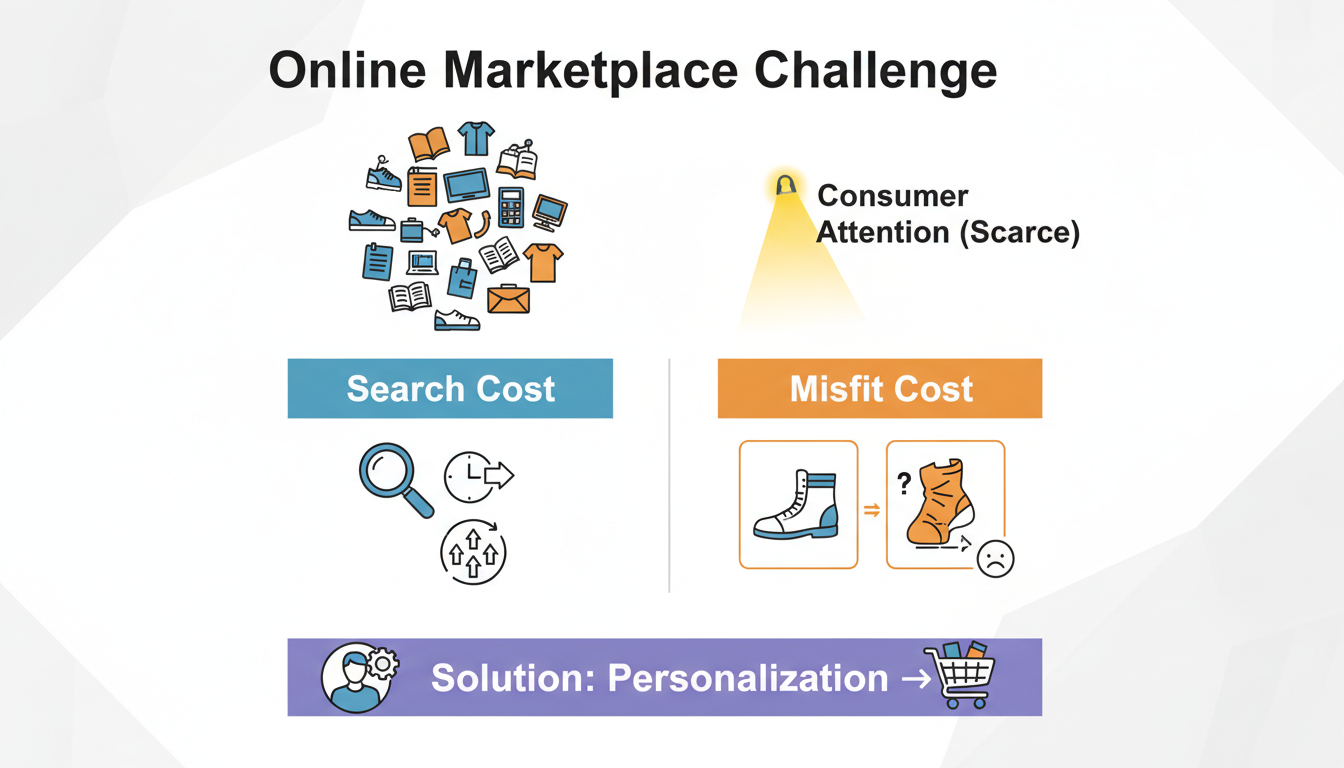
Why Recommender System?
In an online market place, consumers face many options. While information is not a scarcity, consumers’ attention is in such an online marketplace. Therefore, firms’ need to reduce two kinds of costs that consumers face:
Search Cost: Search costs are considered as costs that incur during the search for suitable products. These include explicit costs, e.g., for reaching a store, or implicit costs that incur as a result of the time required for searching the respective item. Decreasing search cost ultimately leads consumers to purchase. Despite consumers facing lower search cost on the Internet, consumers’ face wide variation in their search cost across online retailers.
Mistfit Cost: This cost represents consumers’ loss due to obtaining a product at a location that is different from her ideal location that would have given the consumer maximum benefit.
All online firms try to minimize consumers’ search cost and misfit cost in order to maximize their sales. Firms achieve this by implementing recommender system that simplifies consumers’ purchase decision thereby minimizing their search cost and misfit cost.
How to Recommend?
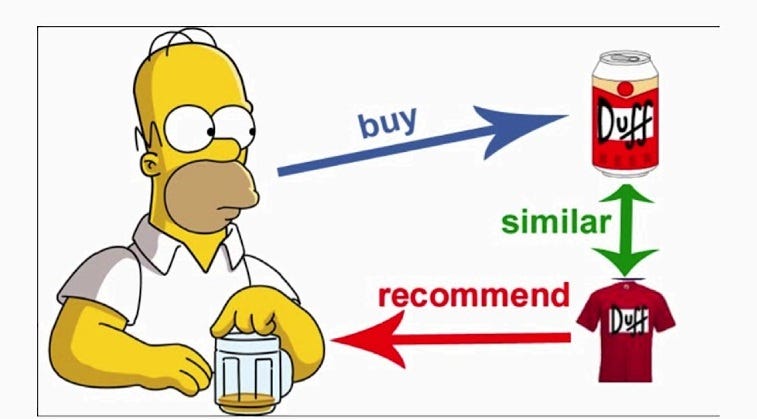
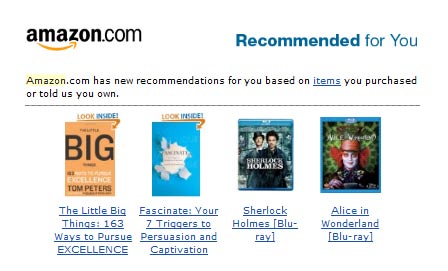
- Recommender System: Recommender systems are popular tools used by online retail websites to suggest products to consumers, such as those featuring music, movies, and other online content.
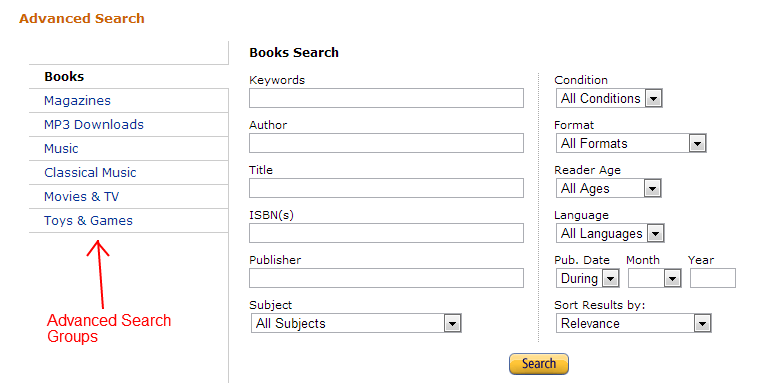
- Search System: Search systems are service provided by the online firms the consumer can use to easily scan huge assortments with the help of search technology.
Types of Recommender System
A typical recommender system problem consist of set of users, \(C\), and set of all possible product items, \(S\), that can be recommeded such as movies, books, restaurants, or hotels. Then, the solution proposed by the recommeder system is to provide items \(s^{'} \in S\) for each user \(c \in C\) such that the user’s utility is mazimized. Based on this formulation, one can design three types of recommedation system:
Content-basedrecommendations: The user will be recommended items similar to the ones the user preferred in the past.Collaborativerecommendations: The user will be recommended items that people with similar tastes and preferences liked in the past.Hybridapproach: These methods combine collaborative and content-based methods.
Search Systems
Search systems helps in reducing the search cost for the consumers, and it is initiated by the consumers.
Consumers can set a list of parameters to refine their search and arrive at precisely preferred products from a huge assortment.
Some online firms “Recommendation Agent” and “Comparison Matrix” into their search systems.
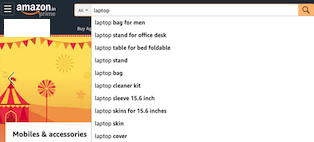
To make search task easier for consumers, search systems implements “autocomplete” feature that makes search faster to complete as users begin to type.
Autocomplete has positive effect on online firms’ sales (NachoAnalytics 2019).
Chatbots
In an offline environment, consumers may have access to the dedicated sales person who can help them through their purchase journey to remove uncertainties, to clarify doubts, to understand their preferences, and to guide them to the best product that suits them. Thus, Conversation drives sales.
But, what about the online marketplace?
Chatbots come handy in taking the role of a dedicated personalized sales person in an online marketplace.
Chatbots are virtual conversational assistants. There are improved version of recommendation systems where consumers can interactively seek help during their purhcase journey.
Chatbots help firms in reducing the cost as well as improving the sales.
AI and Personalization
Automation
Marketing Automation refers to software platforms and technologies designed for marketing departments and organizations to more effectively market on multiple channels online and automate repetitive tasks.
- Email Marketing Automation
- Building email database list
- Validating email addresses
- Enable double-opt in
- Providing email recipients to unsubscribe
- Unsubscribing inactive users
- Setting up email authentication
- Sending email newsletters
- Checking sender reputation
- Gathering email analytics
Use of Generative AI
- Define the campaign objective and target audience
- Create an opt-in list and segment then based on demographics, psychographics, and behavior.
- Develop a personalized email content strategy using AI-powered tools.
- Get ideas for subject lines, email body, and call-to-action (CTA) using AI tools.
- Test and optimize the email content using A/B testing and AI-powered analytics.
- Automate email sequencing and follow-up using AI-powered tools.
AI Tools for Email Marketing
- Text Generation
- ChatGPT
- Jasper.ai
- Compose.ai
- Image Generation
- DALL-E
- MidJourney
- Adobe Firefly
- Nano Banana
CRACK-ing AI in Personalization
CRACK Test of using AI in Marketing
- Clarity of Instructions: Provide AI with clear and concise instructions.
- Relevance of Results: Ensure AI outputs are relevant to the task.
- Accuracy of Results: Verify the accuracy of AI-generated content.
- Creativity of Results: Assess the creativity and originality of AI outputs. (Hint: digital homogeneity)
- Knowledgeability of Results: Evaluate the depth of knowledge in AI-generated content.
Reflect
- Modify the following 3 prompts to run on GenAI (e.g., ChatGPT) to generate email newsletter content:
- Generate an introduction email message for companies in the {INSERT INDUSTRY NAME} industry.
- Generate a follow-up email message for {INSERT COMPANY NAME} in the {INSERT INDUSTRY NAME} industry.
- Create an outline for an email sequence for businesses in the city of {INSERT CITY NAME}.
- Run three separate CRACK test for each promot and reflect on your analyes.
Thank You!
🙏
Q&A
Food for Thought
Cleaning up Opt-in List
What are the ways you can keep your email list up-to-date date?
- Double opt-in
- Alert newsletter
How will you grow your subscriber base?
How to Optimize Email
How does the content of email affect its performance?
- Subject line
- Length of text
- Number of images
- Number of Links
How should you place links in your email newsletter to optimize the click-through rate?
- Placement
- Position
- Color
Which metrics you will use for email newsletter optimization?
- Opt-in success rate
- Retention success
- Delivery success
- Viral effect
Innovations in Email Marketing
Innovations happening in how to execute email marketing program efficiently and effectively.
- Automation
- Personalization
- Device optimization
What is the future of email marketing?
AI in email marketing
Email Marketing: Tools
- MailChimp: Email marketing platform
- Sage-e-CRM: Email marketing platform
- Boomrang: Scheduling your email newsletter using Gmail.
- Crystal: Improve communication by personalizing email contents.
- Clara: Virtual employee that schedules your meetings.
- Constant Contact: An e-mail-marketing vendor that helps individuals and businesses manage their entire social-networking presence via e-mail.
- Iterable: Cross platform integration of email campaigns.
Study one of these tools.
Gmail Inbox Tab
Gmail introduced new inbox tab in June, 2013.
What are its implications on advertisers’ email marketing strategy?
