Foundation of Digital Marketing
Marketing: What we do?
Marketing has been a tradition of understanding market behavior that primarily constitutes buyers and sellers. The Association (2017) defines Marketing as:
However, technological advancements have constantly disrupted traditional marketing activities. Nevertheless, the core actors, i.e., buyers and sellers, and core marketing activities, i.e., marketing research to understand marketing behavior, have remained the same. Association (2017) defines Marketing Research as:
Fundamentally, marketing is about understanding three key concepts:
- Decision-making, consumer choice analysis
- Attachment
- Loyalty
- Identity
- Value creation and co-creation
- Segmentation
- Targeting
- Positioning and Marketing Mix
- Brand Identity and Branding
- NPD
- Innovation
- Relationship Marketing
- Content and Digital Marketing
- Retailing
- Sustainable advantage – e.g., Market Orientation/Intelligence Use
- Dynamic Markets
- Marketing Strategy
- Competitive Advantage
Digital Marketing: Technologies and Markets
Today, the technological revolution brought about by the Internet is transforming the marketing landscape that profoundly impacts two core functions of marketing: buying and selling. Therefore, we need to revisit the various marketing concepts, examining them critically through the lens of recent technological advancements.
The Internet brings about a major technological revolution in the marketplace in the following ways.
First, the Internet has made it possible to create a network of online communities where people can connect and communicate mutually without physical boundaries.
Second, these online networks have made information accessible to a larger segment of people in real-time. No wonder the current economic environment is also called the Information Economy, where the production, dissemination, and manipulation of information is studied in a market context. Thus, information is treated as a commodity in this economy.
However, whereas the marginal cost of production of information is virtually zero, the value to this commodity comes from users’ Attention, which has become a scarce resource in this information economy. Therefore, this economy is rightly also said Economics of Attention. Note that the AIDA model of marketing communication also starts with Attention.
Accordingly, we summarize the following are the important ingredients of digital marketing:
- Internet
- Digital computing tools (computers, laptops, tablets, phones)
- Hardware as well as Software
- Digital networks act as Communication media
- Digital networks act as Distribution channels
- Digital networks act as Connection services
- Information as a signal of Quality
- Information as a tool for Price Discrimination
- Information as a source of competitive advantage
- Knowledge, Idea, Data, Insights, Strategies, Wisdom
- Information as a commodity in the age of the Internet and as an online currency in this attention economy has given rise to various kinds of businesses that cater to the needs of production, dissemination, and management of information (Glazer 1991).
- Information is ample, but Attention is scarce.
Platforms, Channels, and Networks
The basic infrastructure needed for firms to kick-start their idea in a digital economy can be divided into three components:
Platforms: Services that ‘host’ firms (e.g., Amazon’s cloud computing).
Channels: Services that distribute digital products (e.g., Apple’s App Store).
Networks: Services that market the product (e.g., Facebook, Twitter).
The Internet, the backbone of digital economy, plays a critical role as required computation power and storage of data are delivered online thereby providing close integration across these three components. However, the business models built around these three components has gone through tremendous changes.
Some industries focus on platforms to build a thriving ecosystem of software businesses around them. For example, Microsoft focuses on the Windows operating system (that serves as a platform) to allow developers to build myriads of software around it. Thus, the platform becomes the focus of the business.
On the other hand, some industries’ main focus is on a thriving ecosystem of applications built around the platform rather than the platform itself. For example, Apple’s App Store is built upon the idea of marketing and channeling apps to consumers. Thus, the channel becomes the focus of the business.
Furthermore, what started as a Network of People, where, using the Internet, people around the world can connect and communicate with each other, soon evolved into the Internet of Things, where infrastructure is created to connect not only people but all kinds of devices, appliances, and whatnot. In the distant future, the realization of the virtual world will become a reality where the ‘physical location’ of objects will have less and less significance.
We observe how quickly things (people, society, culture, business, economy, etc.) are changing around us in the Internet age. You have to envision a future business model based on the digital economy and explain the important components of that business model. You can explain your business model either around the three elements described above or come up with your own business components that are relevant and scalable in future digital economy.
Defining Digital Marketing
Kannan and Li (2017) defines digital marketing as:
An adaptive, technology-enabled process by which firms collaborate with customers and partners to jointly create, communicate, deliver, and sustain value for all stakeholders.
Given the importance of technologies and networks in shaping the digital marketing landscape, we can define digital marketing as:
Digital marketing is the use of networks created from hardware and software in the process of marketing.
Changes in Digital Marketing Landscape
There are several changes taking place in the market due to the digital revolution. However, within the realm of digital marketing, we will limit our focus on the issues related to customer-firm relationships only.
- Interaction
- Mutual
- Co-creation
- B2C, B2B, C2C, C2B
- Customers want to take part in the production process too, along with consumption
- From Mass Marketing to Customization to Personalization
- Product recommendation
- Customer-centric business model
- Matching: Alignment of the company’s offering with the preferences of its customers. One-to-one marketing
- Marketing Mix Decisions
- Price: price customization, pricing formats and tactics, price discrimination.
- Promotion: Integrated marketing communication now includes traditional (e.g., tv), new (e.g., email), and social media, FGC, UGC.
- Place: Multichannel marketing (e.g., online channel)
- Product: Service-oriented business model and personalized customization.
- Customer Relationship Management
- Database marketing
- Marketing Analytics
- Big Data Challenges, Volume - Variety - Velocity, Data Fusion Techniques
- Drawing Concepts from Varied Fields: Economics - Psychology - Computer Science - Statistics
At the core of all these marketing issues lies information that acts as an activity, life form, and relationship (Barlow 1994).
Some of the fundamental changes that the Internet has brought and changed the traditional marketing models are as follow:
Networked model of competition dramatically increases the speed of change in every part and function of the organization, be it building and delivering a marketing campaign or altering product or service characteristics based on feedback. Thus, it leads to discontinuous innovation rupturing the existing models of marketing (MIT Technology Review 2014).
- The Internet allows small firms to extend the market reach and impact using technological excellence and know-how, and aggressive partnering strategy. Thus, a successful digital business can scale dramatically, threatening existing market players (Wall Street Journal 2015).
The rate of innovation diffusion through the online medium is faster than through conventional channels and thus requires firms to be acutely aware of their time to market (Boston Consulting Group 2018).
Digitally wired consumers’ purchase journey through Consider, Evaluate, Buy also now includes Enjoy, Advocate, Bond. Thus, they are incredibly involved with consumption experience (Edelman 2010).
Customer-orientation is very important in digital marketing. In marketing, we define customer orientation in terms of the shopping behavior of customers that includes their AIO (activities, interest, and opinion) variables. We classify customer orientation into four categories (Lee 2000):
- Recreation Orientation: Customers shop for pleasure.
- Experiential Orientation: Customers like to try, inspect, and feel the products before making a final purchase.
- Convenience Orientation: Customers would like to minimize the time and efforts associated with the purchase process.
- Economic Orientation: Customers do a lot of research before making a final purchase to obtains the best value for their money.
How Information Market Place is Different: Summary
Some of the crucial features of the information that makes it different from other economic goods are as follows:
- Information is costly to produce but cheap to reproduce.
- Production of information has high fixed costs but low marginal costs.
- Information goods are priced according to their value, not according to their production cost.
- Information is an experience good whose value is known to consumers only after it is consumed.
- A wealth of information created poverty of Attention. Therefore, information search plays a critical role in attaining quality information.
- In an information economy, firms need to focus not only on competitors but also on collaborators and complementors.
- Apart from providing quality, firms can maximize their profits from information goods by consumers and setting high .
- Feedbacks are an important mechanism of the growth of information goods.
- Network effects or network externalities1 play a major role in the feedback mechanism.
Some of the important digital strategies that are important for sustaining long term growth are:
- Differentiate your product.
- Achieve cost leadership.
- The first mover has an edge in this competitive environment.
- Customization: Personalize your product and price.
- Know your customers well.
- Price your product creatively: High pricing, Low pricing (price penetration), Differential pricing.
- Personalized pricing: Sell to each user at a different price. (First Degree Price Discrimination)
- Offer a product line and let users choose the version of the product most appropriate for them. For example, such as quantity discounts for bulk purchases. (Second Degree Price Discrimination)
- Group pricing: Set different prices for different groups of consumers. For example, airline travelers can be subdivided into frequent flyers and casual flyers, and cinema goers can be grouped into adults and children. (Third Degree Price Discrimination)
- Use promotion with a mix of traditional, new, and social media to reach your existing and potential customers.
Search Economy
In a digital economy, anything that can be digitized, i.e., can be represented as a stream of bits, is information. With the ever expansion of technology and the benefits of information goods, there is an explosion of information. However, to make a meaningful decision, we need to extract knowledge from this information.
DATA -> INFORMATION -> KNOWLEDGE -> WISDOM
Therefore, to arrive at meaningful information (i.e., knowledge), one needs to search for it in the ever-growing heap of data. Thus, in this digital world, search is going to be very important. In a marketing context, search is important because of the following reasons:
- There is information asymmetry among buyers and sellers.
- A key issue in the context of Internet-based selling of search goods involves the optimal level of information to be provided by sellers.
- The efficiency of the market is often determined by the level and quality of the information possessed by the market agents.
Consumers incur various costs (e.g., financial, physical, mental, physiological) while searching for information (Coiera 2000). Therefore, how long or how much will consumers be willing to search for information? Based on the utility optimization behavior of rational consumers, we can safely say that as long as the marginal benefits of information search outweigh the marginal cost of information search, consumers will tend to search for one extra bit of information.
Many companies started their business based on information search. Immediately marketers realized the potential benefits of advertising on such search platforms. However, fierce competition for seeking Attention and ever-changing search algorithms has led marketers to optimize the effects of their ads on search engines leading to a new marketing field, often called Search Engine Optimization (SEO) and Display Ads.
Decoupling
There is a difference between technological innovation and business model transformation. Digital transformation carried out solely based on technological innovation fails to bring disruption unless it is also accompanied with business model transformation. Disruption in the marketplace are brought by consumers not technologies. Thus, disruption refers to an abrupt and sizable change of market share among participants in an industry (Teixeira and Piechota 2019).
In a traditional marketing environment, an incumbent or a focal firm provides all the services related to a typical customer value chain:
\[ Evaluate \rightarrow Choose \rightarrow Purchase \rightarrow Consume \]
However, with disruption brought about by digital transformation (it includes both technological innovation and business transformation), the customer value chain has been disrupted. While it poses a threat to the incumbent, it also provides opportunities for new market entrants. This phenomenon is called decoupling of customer value chain.
Digital Transformation
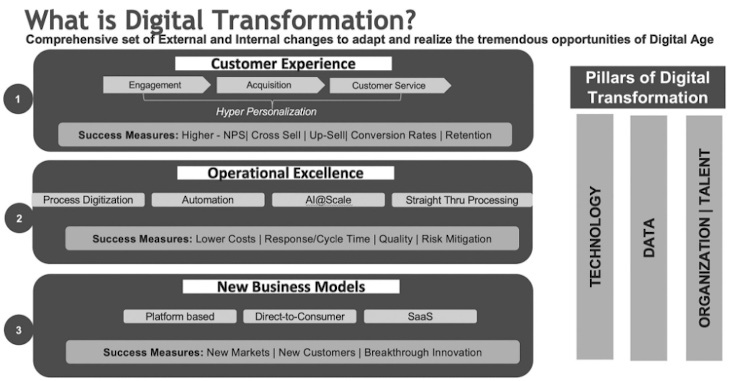
Digital transformation is companies technological initiatives to improve the following: customer interaction, operation, and business models.
Technology Trend Outlook
McKinsey (2025) has come up with a report titled “McKinsey Technology Trends Outlook 2025” that list the following 13 tech trends.
AI Revolution
- Agentic AI
- Artificial Intelligence
Compute and Connectivity Frontiers
- Application-specific semiconductors
- Advanced connectivity
- Cloud and edge computing
- Immersive-reality technologies
- Digital trust and cybersecurity
- Quantum technologies
Cutting-edge Engineering
- Future of robotics
- Future of mobility
- Future of bioengineering
- Future of space technologies
- Future of energy and sustainability technologies
McKinsey’s 2024-2025 technology trends analysis identifies generative AI as the standout trend, with a 700% spike in Google searches and remarkable innovation including context windows expanding from 100,000 to 2 million tokens, enabling integration across enterprise software and diverse applications from chatbots to drug discovery.
References
Footnotes
When the value of a product to one user depends on how many other users there are, the product is said to exhibit network effects.↩︎